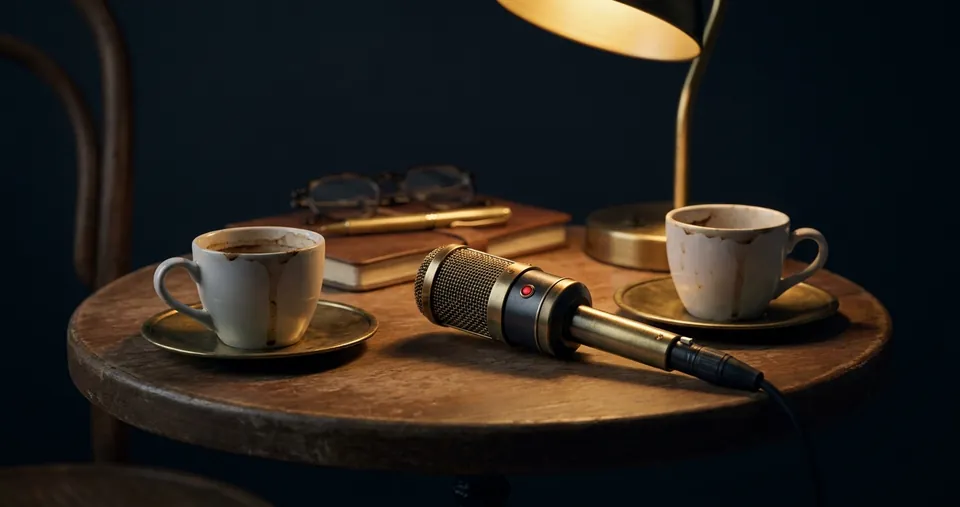
What if we'd recorded this?
I sat in a café the other day and talked with someone for fifteen minutes. A concrete problem, an idea for how to solve it, a couple of exchanges back and forth. A good conversation. We both know the pipeline inside and out -- record, transcribe, feed into a model, and you have a requirements picture, the next questions to ask, the start of a deal.
And neither of us hit record.
What Was Actually on the Table
It hit me only afterwards. If we'd recorded those fifteen minutes, the work would already be half done. The transcript against the client's material would have given us the exact use case. Five Socratic follow-up questions would have been sitting there waiting for the next step. Instead it's gone, and I'm reconstructing it from memory -- the way I always do -- worse than if I'd had the raw material.
It wasn't a technical problem. It wasn't that we didn't know how. It was that we didn't do it.
The Gap That Is Not a Knowledge Gap
This is the uncomfortable part of everything I write about voice. I have written for years that voice is the underused input layer, that a fifteen-minute conversation carries more than a form, that the only job is to capture and steer. And here I am, sitting in a café, letting one of the better conversations of the week drain away.
The gap isn't capability. We know how. The gap is habit. Knowing that voice is the input layer and actually pressing the button are two different things, and it's the second one that pays.
What Has Been Ready for a Long Time
The technology has been ready for years. It was never the bottleneck. Whisper was good enough for this long before the models became what they are now.
The only thing that hasn't been ready is the habit of hitting record before the conversation starts, instead of realising its value once it's over. And habit is the only thing that counts.
See also: Everything I Say Ends Up as Text (series 2) and Three channels, one place.